Floor Deck Machine Gauge: 0.7–1.5 vs 2.0–3.0 mm
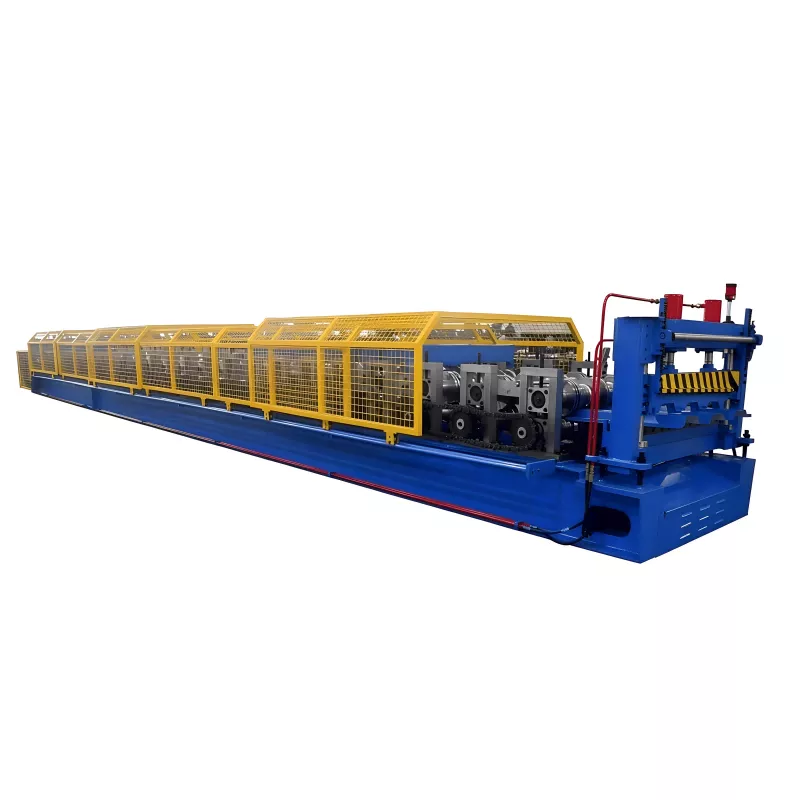
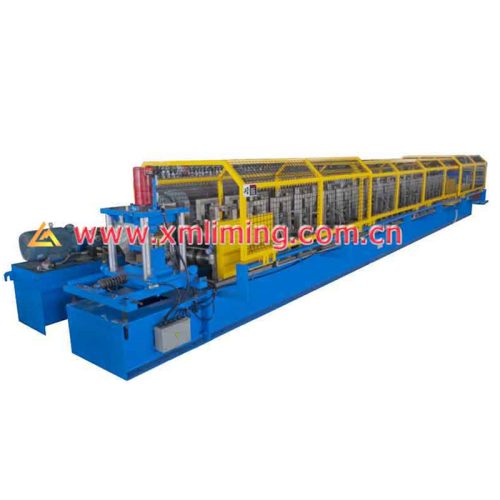
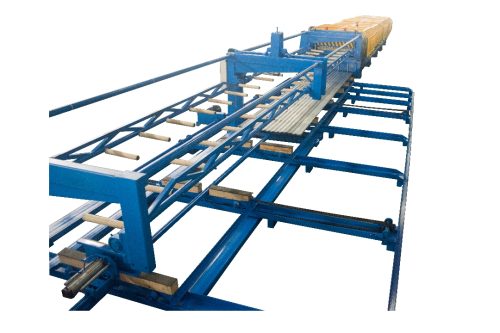
Floor deck machine gauge is never a single number. Machines are built in three tiers — standard 0.7–1.5 mm, heavy-gauge 2.0–3.0 mm, and a medium-gauge combo — and no line crosses between them by swapping rolls. Forming force, pass count, frame rigidity, motor power and shear method are all re-engineered across that span, which is why the gauge range belongs in the first line of any enquiry.
Step 2 of 5 · Back to the 5-step framework · Xiamen ZhengLiming Metallurgical Machinery
Three floor deck machine gauge tiers
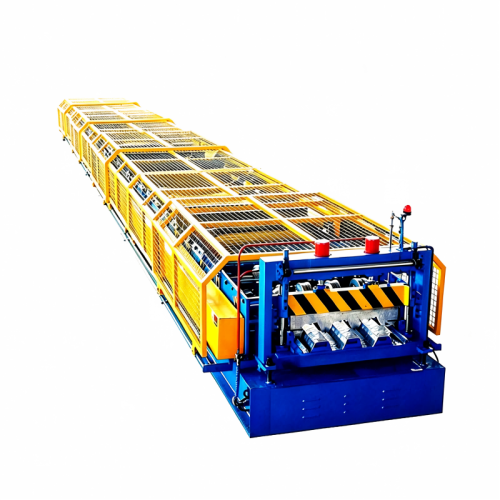
Standard tier: 0.7–1.5 mm. Runs the conventional coil grades — 235 and 355 MPa galvanized and galvalume — and covers most industrial plants, warehouses and commercial buildings. Drawings usually call for 0.8–1.2 mm; the 1.5 mm ceiling is proven on delivered export machines.
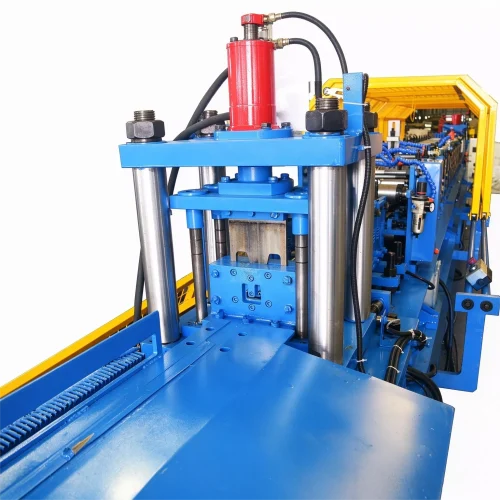
Heavy-gauge line: up to 2.0–3.0 mm. In service on delivered machines. Built for heavy-duty plants, composite beams and composite slabs, long-span public buildings, and projects designed to overseas thick-plate standards.
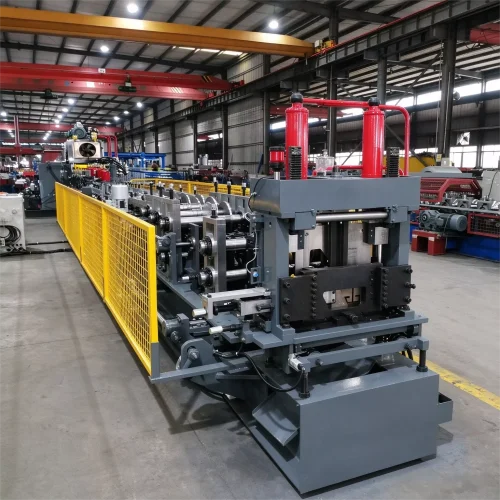
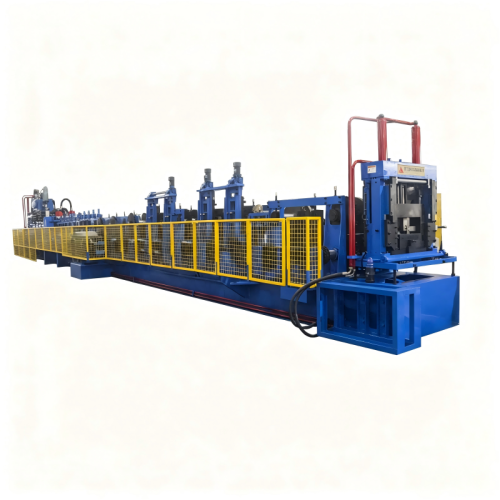
Medium-gauge combo: 1.5–3.0 mm. A dedicated dual-purpose line that also runs C purlins, with computer-controlled changeover. It is a different machine, not the heavy-gauge line with extra tooling. Details on the combo machine.
Tiers are not interchangeable
No floor deck machine gauge crosses tiers by swapping tooling. Gauge spans a factor of more than four, and the builder sizes everything downstream of the roll stand for the tier at build. Do not expect to cover a 0.7–3.0 mm span by changing roll sets: the frame, the drive and the shear are all redesigned for the tier, not re-tooled.
The heavy-gauge line needs higher forming tonnage, thicker frame walls, a hydraulic shear instead of a mechanical one, and its speed is derated accordingly. A frame built for 1.5 mm will not hold tolerance at 3.0 mm however many rolls you add.
So state the gauge range first. Quoting a heavy-gauge line against a thin-gauge budget produces a proposal that means nothing, and the error is usually discovered after the deposit.
What a drawing means by "1.2 mm"
Gauge is the steel base thickness, and two things about the number trip up buyers who compare quotations on the strength of it.
Mills roll coil to a tolerance band, not to a single number. A sheet specified at 1.2 mm may measure 1.14 mm at the thin end of the band and still be in specification. That is normal, and it is why the machine's upper limit matters more than the nominal figure: if a line is built for exactly 1.5 mm and a coil arrives at 1.54 mm, the last stands load up and the drive trips.
Coating is not gauge. A Z275 galvanized sheet carries roughly 275 g/㎡ of zinc across both faces — about 20 microns per face, 0.04 mm in total — and none of it counts toward the steel thickness. Galvalume and Al-Mg-Mn coatings work the same way. When a supplier quotes "1.2 mm", ask whether that is the base metal or the finished sheet; the two differ by more than the tolerance band.
Coil materials
Galvanized (GI) — good corrosion protection, the default for industrial and commercial buildings.
Galvalume (GL) — higher corrosion resistance than standard galvanizing.
Al-Mg-Mn alloy — lightweight and highly corrosion-resistant; airports and large public venues.
High-strength steel, 550 MPa — a special-order grade, not the mainstream choice; most thin-gauge deck runs 235 / 355 MPa coil.
Medium plate, 235 / 355 MPa — cold-rolled or galvanized, standard for 2.0–3.0 mm deck.
Roll tooling: thin gauge judges the surface, thick gauge judges the substrate
Two roll specifications appear in quotations, and they divide the work by duty rather than by quality.
45# steel with hard chrome is the thin-gauge answer. Surface hardness comes from the plating, applied over a mirror finish of Ra ≤0.8 μm, and finished deck holds ±2 mm overall dimensional tolerance. Service life runs 8–10 years under normal maintenance, and you can strip and renew the plating when it wears — which keeps the maintenance cost low. Thin gauge at high speed and light load is exactly what a plated roll is good at: the surface is what wears, so the surface is what you maintain.
Cr12 cold-work tool steel is the medium-gauge answer. It hardens through the section rather than at the skin, so it resists local wear-through and survives contact stresses that would simply crush a plating layer. At 2.0–3.0 mm the deformation work per bite is high enough that surface hardness alone is not a strategy. Shafts on the combo machine are 45# steel, φ75 mm, quenched and tempered.
One line to remember: thin gauge, judge the surface; thick gauge, judge the substrate. A quotation offering Cr12 on a 1 mm line is not upgrading you, and one offering plated rolls on a 3 mm line is a warranty claim waiting to happen.
Floor deck machine gauge: three-tier comparison
| Item | Standard 0.7–1.5 mm | Heavy-gauge 2.0–3.0 mm | Combo (deck + C purlin) |
|---|---|---|---|
| Gauge | 0.7–1.5 mm (drawings usually 0.8–1.2) | up to 2.0–3.0 mm | cold-rolled and galvanized, 235 / 355 MPa |
| Materials | GI / GL / Al-Mg-Mn, 235 / 355 MPa (550 MPa HSS on request) | mainly HSS, per project | cold-rolled and galvanized, 235 / 355 MPa |
| Forming passes | 26–38 on delivered machines | increases with gauge | 22 (20 main + 1 ribbing + 1 straightening) |
| Forming speed | 6–20 m/min (export machines 15–20) | 4–12 m/min, overall incl. punching and cutting | roll-forming section ≤30 m/min |
| Rolls | 45# steel, CNC + heat treatment + hard chrome, Ra ≤0.8 μm | as standard, heat treatment reinforced | Cr12, heat-treated and polished; shaft 45# φ75 |
| Control | Siemens PLC + touchscreen | as standard | Siemens PLC + touchscreen + Omron encoder |
| Drive | geared motor + gearbox; twin or triple motors above 600 mm | uprated power | 40 kW servo + 11 kW hydraulic unit |
| Shear | hydraulic cut-to-length | heavy-gauge hydraulic shear | hydraulic universal shear, Cr12MoV blades |
| Punching | optional | optional | standard, 3 stations, 14×22 mm |
| Installed power | per configuration | per configuration | ≈55 kW, reserve 80 kVA |
| Warranty | 1 year | 1 year | 1 year |
Do not read across the speed row without the definitions behind it — the two figures are counted differently. What the speed numbers actually mean.
If heavy plate is a small part of your book
Not every fabricator needs two lines. If 2.0–3.0 mm work is a small share of your order book, a standard line plus subcontracting the occasional heavy job keeps capital on your mainstream profiles, and the arithmetic usually favours it below roughly 10–15% heavy-gauge volume.
The alternative is the combo machine, which covers medium gauge and C purlins in one footprint — but it is a compromise on any single product and does not substitute for a thin-gauge line.
Three questions buyers ask here
Can a standard line be upgraded later to 3.0 mm?
Not on the same frame. The builder sizes frame walls, forming tonnage, drive and shear for the tier at build. Changing tier later means a new machine, which is why the gauge decision is worth getting right the first time.
Does gauge include the zinc coating?
No. Gauge is the steel base thickness; coating weight is a separate specification. Say which one you mean when comparing quotations.
What tolerance should I expect on finished deck?
±2 mm overall on the finished deck — profile dimensions and cut length included — on both standard and heavy-gauge lines.
Send your floor deck machine gauge requirements: the gauge range and the material grade. We will confirm the tier, the roll specification and the frame size it implies — within 24 hours.
Other guides in this framework
- Step 1 — Floor deck profiles: open, closed, dovetail and truss Which section, and what it does to the tooling
- Step 3 — Forming passes, line speed and output 38 vs 22 passes, and why neither is a downgrade
- Step 4 — No-pour deck and C purlin combo machine The third tier, in full
- The 5-step framework Back to the overview