Solar Mounting Rail Roll Forming Machine: How to Choose for U4141 & U4121
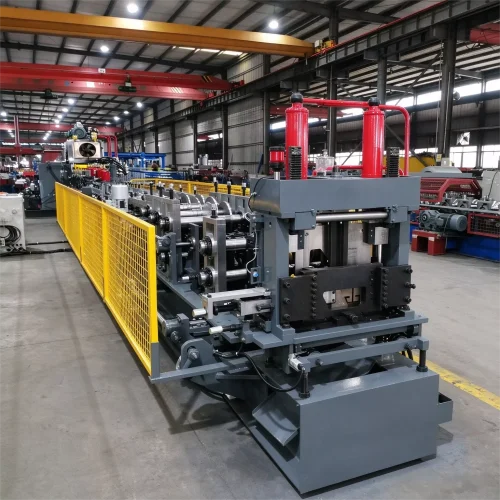
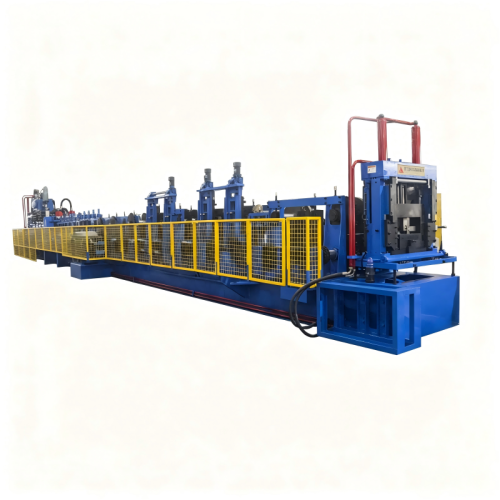
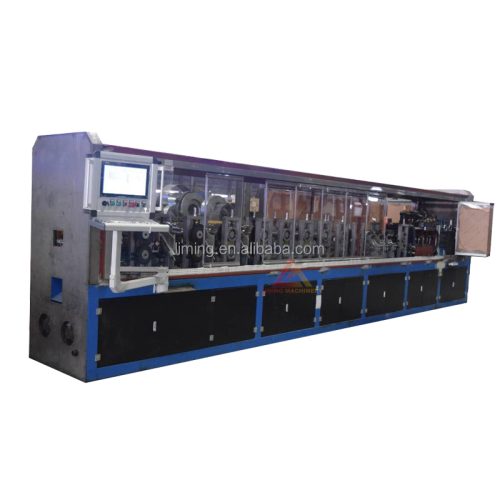
Choosing a solar mounting rail roll forming machine comes down to four things: which profiles you need, what coil you run, what hole pattern your drawings call for, and how fast the line must run. This guide walks through each of them, using our dual-cassette platform as the reference. U4141 (41×41 mm) and U4121 (41×21 mm) are covered in detail, along with other 41 mm strut channel profiles.
Solar mounting rails hold PV modules in place. Rooftop systems and ground-mounted solar farms both use them. Factories make almost all of them on a roll forming line.
Note: this page is a buying guide for the equipment — how to compare profiles, coil, punching and speed before you request a quotation. If you want the full machine specification and pricing, see our solar mounting roll forming machine product page. If you want finished rails or a complete racking system, this is not the right page.
The Five Decisions That Drive Price and Fit
Most buyers compare quotations on price alone. That is the wrong starting point. Five decisions drive both the price and the fit — settle them before you request a quote.
1. How many profiles will you run?
Count the sections in your order book. If U4141 and U4121 both appear regularly, a dual-cassette line pays for itself: the changeover is a cassette swap instead of a re-rolling job. If one section accounts for more than 90% of your volume, a single-profile line is cheaper and you lose very little.
2. What coil will the line see?
State the coating, not just the steel grade. GI class (Z275 or above) and ZAM need different roller polish grades and lubricants. A line built for ZAM runs GI without change; a line built only for GI does not automatically handle ZAM. Getting this wrong is expensive to fix later.
3. What hole pattern do your drawings specify?
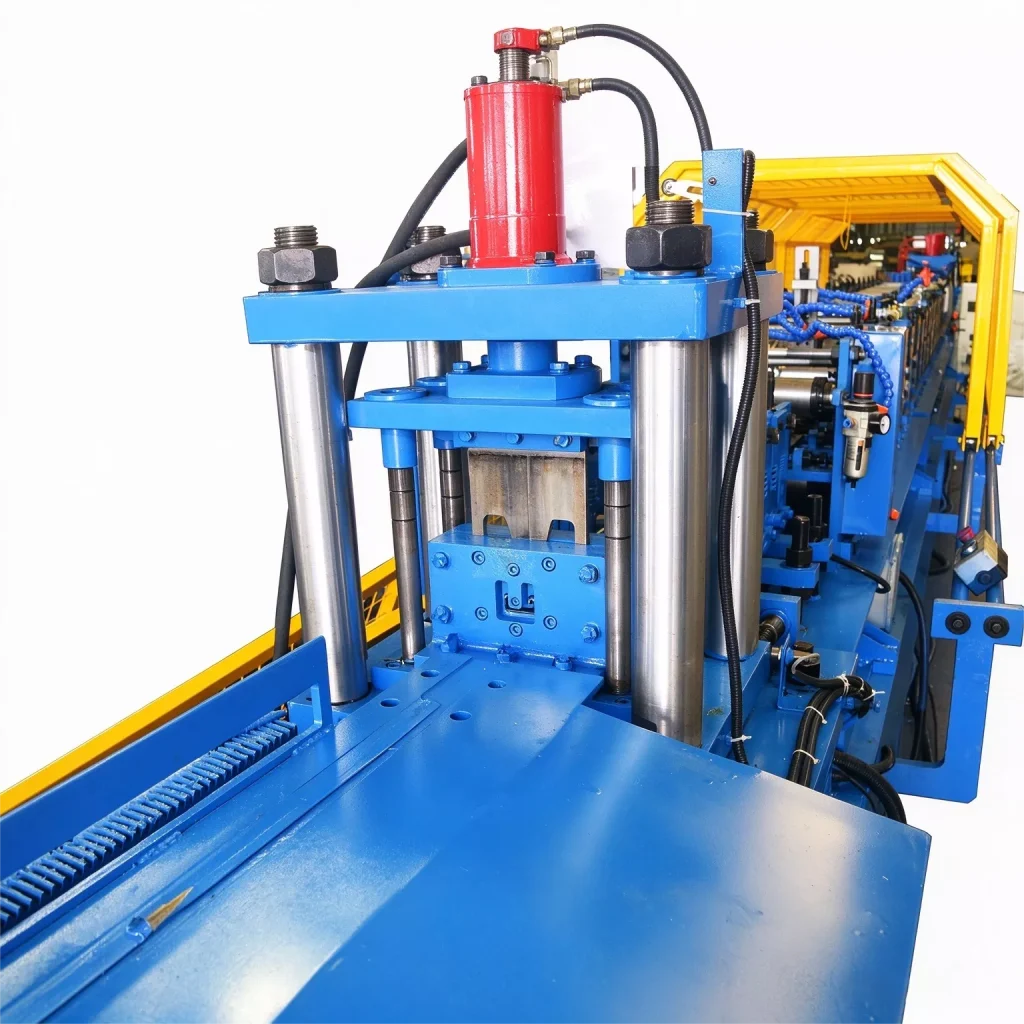
Slot size, step and face matter more than most buyers expect. Holes on flat strip suit pre-punching — the accurate, simple route. Holes that must land on the curved face of a closed section need post-punching. Send the drawing with the quotation request; the punching station is designed around it.
4. What output do you actually need?
Forming speed and punching speed are different numbers. If punching is not on your line, size the machine by forming speed alone. If it is, punching sets the pace — a faster forming section buys nothing.
5. What accuracy and delivery window?
Installers set rails flush against module frames, so cut length tolerance is a real constraint, not a spec-sheet detail. Tighter than ±2 mm is possible but costs cycle time. On delivery, ask for a schedule tied to your drawing approval, not a generic lead time.
U4141 vs U4121: Which Profile Should Your Line Prioritize?
The 41 mm slotted strut channel is the world standard for PV mounting hardware. Clamps, T-nuts and splice plates are all designed around this module. So fabricators stick to it. The two most common variants differ mainly in depth, pass count and load capacity — and that difference is what should drive your profile priority.
| Profile | Section (W×H) | Forming passes | Feed width (approx.) | Typical use |
| U4141 (U41×41) | 41 × 41 mm | 18 | ~ 134 mm | Heavy rails, ground-mount frames |
| U4121 (U41×21) | 41 × 21 mm | 16 | ~ 94 mm | Light rails, module clamping rails |
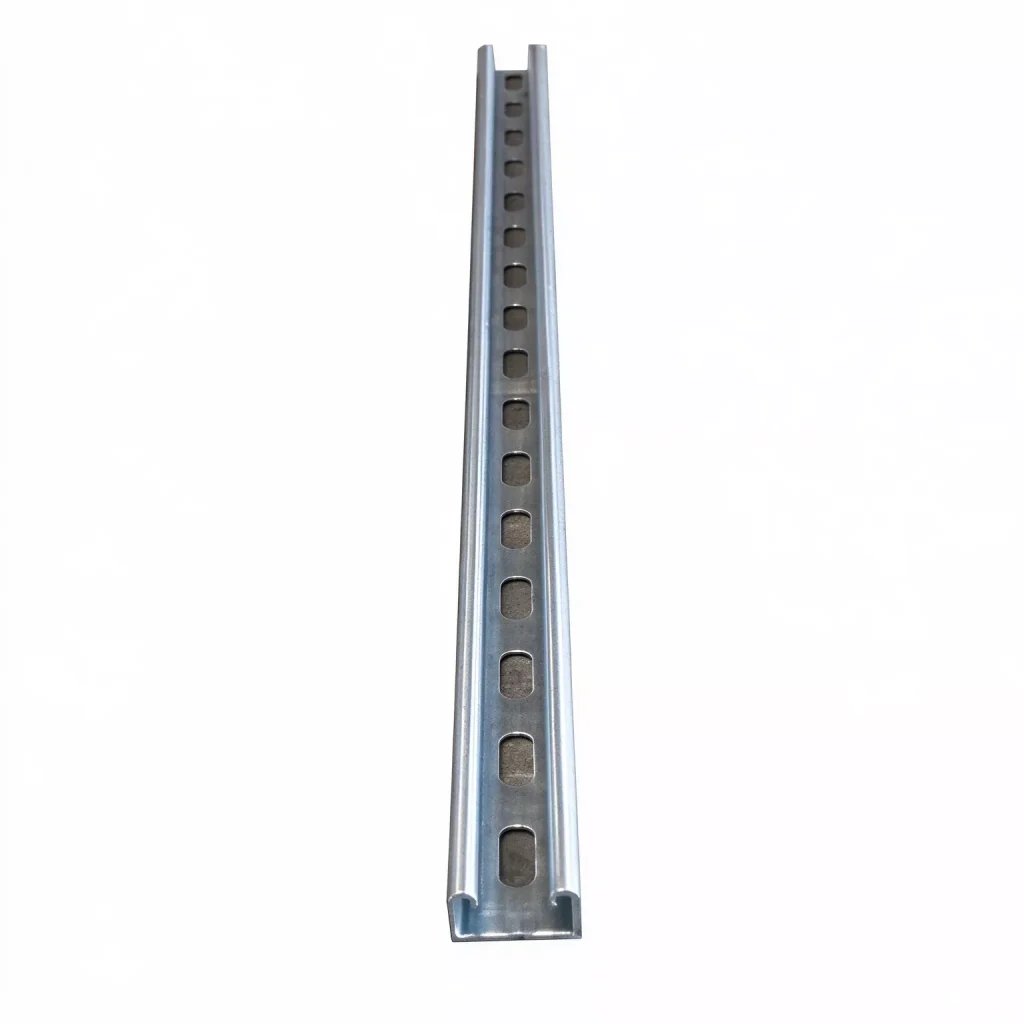
U4141 (41×41 mm) — choose it for long spans and heavy loads
The deeper section gives the U4141 rail a higher moment of inertia. It suits long spans and heavy loads.
Typical uses: ground-mount solar farm tables, carport structures and main rooftop rails. The slots face inward and accept standard T-nuts. Module clamps slide to any position without drilling. Forming this section takes 18 passes on a U4141 roll forming machine — one more reason a dual-cassette line is worth considering if you also run U4121.
U4121 (41×21 mm) — choose it for material saving and light loads
The U4121 section saves material and weight. It usually works as the secondary rail that clamps the modules. It also suits short rooftop spans with limited load reserve.
On a U4121 profile machine, it forms in 16 passes instead of 18, giving a slightly higher line speed. If U4121 dominates your order book, a single-profile line sized to 16 passes is the lower-cost route.
Which one to prioritize? When more than half your projects are ground-mount or carport, choose U4141 first. When most work is rooftop retrofit or module clamping rails, choose U4121 first. If both are regular, choose dual-cassette.Full section drawings and machine parameters are on the U4141 and U4121 machine specification page.
GI vs ZAM: Which Coil Should You Specify?
We build solar rail machines for three material families. The right choice depends on the project environment and the coating requirement. The machine configuration changes with the material: roller surface treatment, lubrication and pass design.
| Material options for solar mounting rails | |||
| Material | Thickness range | Corrosion protection | Typical market |
| Hot-rolled structural steel (235 MPa) | 1.0–2.5 mm standard | Post-coating needed (paint or HDG after forming) | Cost-driven projects with local galvanizing |
| Hot-dip galvanized coil (GI, ASTM A653 / EN 10346) | 1.0–2.5 mm standard | Zinc coating Z275–Z600 typical | Standard rooftop and ground-mount |
| Zinc-aluminum-magnesium (ZAM) | 1.0–2.5 mm standard | Cut-edge protection 3–5× plain zinc | Coastal, humid and desert sites |
1.0–2.5 mm 235 MPa Structural Steel — the lowest-cost route
The standard machine forms 1.0–2.5 mm hot-rolled steel at 235 MPa yield. Some customers galvanize after forming. For them, black coil is the lowest cost route. The pre-punching unit delivers the hole pattern before the section closes. Choose this when local galvanizing capacity exists and the project is cost-driven.
Hot-dip galvanized (GI) coil — the mainstream default
GI coil is the mainstream choice for PV mounting. The zinc layer must survive forming without flaking. So roller surfaces are polished or chrome-plated. Forming speed is matched to the coating class (Z275 and above). Specify the coating when ordering. It affects roller design and lubrication.
Zinc-aluminum-magnesium (ZAM) coil — for coastal, humid and desert sites
ZAM protects cut edges far better than plain zinc. Coastal and desert PV projects rely on it. Forming ZAM demands more from the machine. The coating is harder than GI. Roll surfaces need a higher polish grade. Passes are checked against scratching. Lubricants must not stain the aluminum-magnesium layer.
A solar rail forming machine configured for ZAM runs GI coil directly. The reverse is not always true. So state your material when you order.
Which one to specify? For coastal, high-humidity or desert projects, specify ZAM at inquiry. For inland rooftop and ground-mount work, GI Z275 is the practical default. Where local galvanizing exists and cost rules, black coil plus post-HDG works.
Pre-Punch vs Post-Punch: Which Fits Your Hole Pattern?
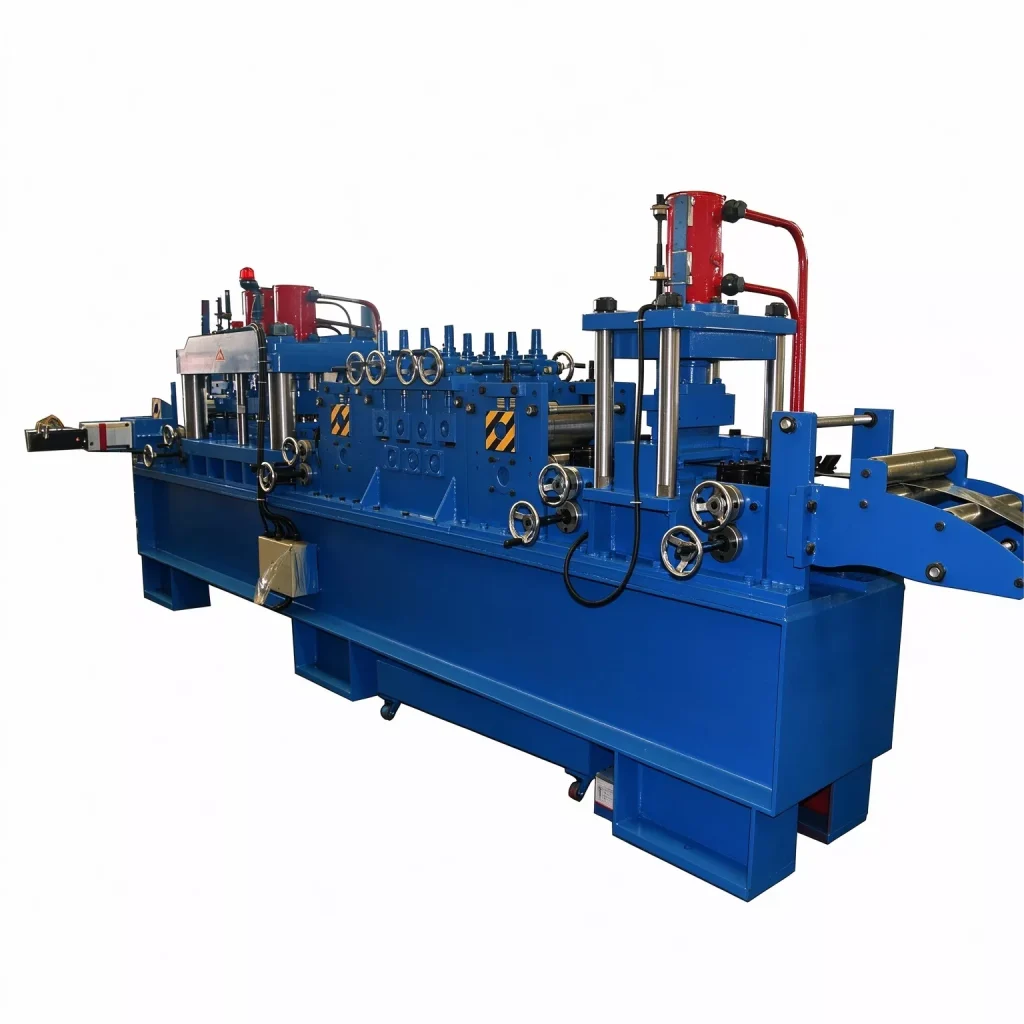
Pre-punching on flat strip gives the best hole accuracy. Tooling is simpler too. It suits fixed patterns like the 600 mm module step. Post-punching is only needed in two cases. First, holes must sit on the curved face of a closed section. Second, hole patterns vary too much to pre-punch. For U4141/U4121 solar rails, pre-punch is the standard choice. The slots face inward, and the strip is flat at punch time.
Which one fits your drawing? If your slots sit on the flat web at a fixed step, pre-punch. If they must land on a curved face or change too often, post-punch. Send the drawing with the quotation request — the punching station is designed around it. Optional punching station details are on the pre-punch station options page.
Dual-Cassette vs Single-Profile Line: When Does the Swap Pay Off?
On a conventional line, switching from U4141 to U4121 means re-rolling tooling. That costs hours of downtime. Our dual-cassette design carries both tooling sets on quick-change cassettes: 18 passes for U4141, 16 for U4121. A profile change becomes a cassette swap.
You get one line, one operator team and one floor footprint instead of two. The Siemens PLC stores recipes for both profiles. Changeover is a touch-screen selection, not a mechanical project.
When does the swap pay off? If both U4141 and U4121 appear regularly in your order book, dual-cassette pays back in avoided re-rolling downtime. If one section dominates more than 90% of volume, a single-profile line is cheaper and you lose very little. Full dual-cassette configuration is on the dual-cassette line specification page.
Why Solar Rails Are Made on a Roll Forming Line
Every fixed-tilt PV array rests on formed steel. Rails carry the modules. Brackets fix the rails to the roof or ground. Together they form the solar panel mounting structure.
One project can need kilometres of rails. So the line must keep forming, punch accurately and cut to length without stopping. Roll forming meets all three requirements at once. That is why virtually every solar strut channel on the market comes off a roll forming production line.
Solar Mounting Brackets on the Same Platform
Rails are only half of the hardware set. The same product family includes solar mounting brackets made from narrower coil: mid-clamps, end-clamps, L-feet, splice plates and adjustable tilt legs. These flat parts run on the same class of roll forming or punching lines. So one solar mounting rail forming machine covers most of the solar panel support bracket range.
Finished solar mounting brackets and solar panel support brackets are usually sourced separately from the machine — confirm the scope with your supplier at inquiry stage.
Other Solar Profiles: C, Hat, CZ and Sigma Channels
Our solar rail machine forms more than the two U sections. Fitted with closed-lip C-channel tooling, it works as a solar C channel roll forming machine for module rails and tilt-leg members where a stiffer lip is needed.
Hat channels are trapezoidal and flat-topped. They fit walkway framing, ballasted flat roofs and cable spacing under the rail. CZ and sigma channels work for tilt legs and bracing in shallow sections.
Each section needs its own tooling set. Cassette-based designs let one line switch between profiles. Tooling is made to customer drawings — send your section drawing to confirm we can form it.
Why 41 mm Became the Solar Strut Channel Standard
The 41 mm slot geometry comes from the European strut channel tradition. Major racking suppliers standardized their clamps and T-nuts on it. Every fabricator that followed had to comply. The accessory ecosystem, not the steel, locked in the standard.
For a machine buyer this matters. A roll forming line that produces true U4141/U4121 geometry accepts the entire catalogue of standard PV mounting hardware.
Solar Strut Channel vs Building C/Z Purlin: Why One Line Can't Do Both
Buyers often ask: can a purlin line make solar rails, or the other way around? Both are open channels. Both can be galvanized. But they are different products with different standards. Building Z purlins are primary structural members; PV modules are normally fixed to solar rails, not directly to Z purlins.
Cross-section and load direction
A C/Z purlin spans metres between portal frames. It carries roof and wind loads. Webs run from 100 mm up to 250 mm and above. A solar strut channel works differently. It carries a distributed module load between attachment points hundreds of millimetres apart, at a fixed 41 mm module. Section depths differ by a factor of five or more. One set of roll tooling cannot form both products.
Coating and standard requirements
Purlins are structural building components. They are typically ordered with Z275+ galvanizing or post-galvanizing. Solar rails face the same outdoor exposure but at lighter gauges. The industry leans on ZAM for cut-edge protection. Material practices differ when a factory runs both products on adjacent lines.
Can one machine produce both?
Economically, no. Pass designs, shaft spacing and punching forces all differ. Fabricators who make both products run a dedicated line for each. That is why we build both platforms. We can recommend the right combination for your order book. See our purlin roll forming machines for the structural side of the product family.If you need the section-level detail on building purlins for PV structures rather than the machine, our guide to C and U sections for solar mounting structures covers it.
Common Buying Mistakes
These are the mistakes that cost the most to fix after the machine is built:
- Quoting only on price. A cheaper line that cannot run your ZAM coil or your hole pattern will cost more in downtime and rework than the price difference.
- Not stating the coating class. GI Z275 and ZAM need different roller polish grades and lubricants. Telling the supplier only "galvanized" is not enough.
- Ignoring the hole pattern. Slot size, step and whether holes sit on flat strip or a closed face decide the punching station. A drawing sent late changes the design.
- Oversizing forming speed. If punching is on your line, punching sets the pace. A faster forming section buys nothing.
- Assuming one line can do both purlins and solar rails. Pass designs, shaft spacing and punching forces differ. Two dedicated lines are the economic route.
- Not tying delivery to drawing approval. A generic lead time means nothing. Ask for a schedule tied to your drawing approval and down payment.
Technical Specifications
The table below describes our standard dual-cassette solar mounting rail roll forming machine. Every line is built to your profile drawings, coil specification and output target. The right-hand column shows what can be adapted.
| Solar mounting rail roll forming machine — standard configuration and customization range | ||
| Item | Standard configuration (U4141/U4121) | Customization range |
| Profiles | U41×41 (18 passes), U41×21 (16 passes), feed ~134 / ~94 mm | Other sections per drawing (CZ, sigma, hat) |
| Material | 1.0–2.5 mm, 235 MPa Hot Rolled Coil | GI (ASTM A653 / EN 10346), ZAM, per coating class |
| Uncoiler | 3-ton driven, max coil width 300 mm, ID 400–610 mm | Coil weight and width per project |
| Pre-leveling | 4-over-3 multi-roll | - |
| Feeding | Servo feeder, powered rollers, programmable length | - |
| Punching | Not included in the standard configuration; optional inline punching available — send your hole pattern drawing for a quotation | Hole pattern per drawing; step programmable |
| Main drive | 30 kW VFD motor | Per output target |
| Speed | 25 m/min forming (punching optional) | Per configuration |
| Cutting | Hydraulic non-stop flying cut, Cr12MoV blades, two sets | Blade sets per profile |
| Tolerance | Cut length ≤ ±2 mm | Tighter tolerance on request |
| Control | Siemens PLC, Schneider inverter, Omron encoder, touch screen | Brand per customer standard |
| Cooling | Roller water circulation + control box cooling | - |
| Safety | Full mesh guarding | CE / local requirements |
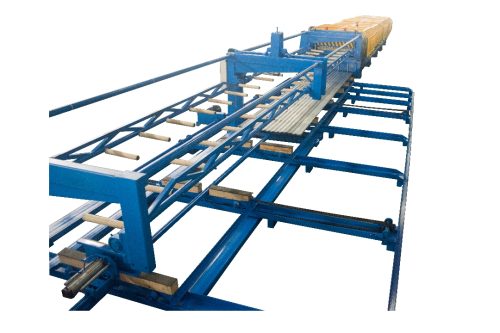
| Product rack | Unpowered, 6 m length | Powered stacking optional |
| Voltage | 380 V/50 Hz or 480 V/60 Hz | Per destination |
| Warranty | 12 months (mechanical parts) | - |
These figures cover the rail profiles. The complete machine includes uncoiler, leveling, servo feed, optional punching station and hydraulic cut-off. Full details and pricing are on the solar mounting roll forming machine product page.
FAQ: Choosing a Solar Mounting Rail Roll Forming Machine
Which profile should I prioritize, U4141 or U4121?
When most projects are ground-mount or carport, prioritize U4141. When most work is rooftop retrofit or module clamping rails, prioritize U4121. If both appear regularly, choose a dual-cassette line.
Which coil should I specify for a coastal project?
Specify ZAM at inquiry. ZAM protects cut edges far better than plain zinc, which matters in salt-spray environments. A ZAM-configured machine runs GI coil directly, so you keep flexibility.
Should I choose pre-punch or post-punch?
Pre-punch for flat-strip slots at a fixed step, such as the 600 mm module step. Post-punch only when holes must land on a curved face of a closed section or patterns vary too much to pre-punch.
When is a dual-cassette line worth the extra cost?
When both U4141 and U4121 appear regularly in your order book. The swap becomes a cassette change instead of a re-rolling job. If one section dominates more than 90% of volume, a single-profile line is cheaper.
What speed do I actually need?
Size by the bottleneck. If punching is on the line, punching sets the pace at about 7 m/min depending on hole pattern. If not, size by forming speed, up to 25 m/min.
Can the machine be customized for C, hat or other profiles?
Yes. C, hat, CZ and sigma channels can be added as tooling options made to customer drawings. Where pass counts allow, the cassette concept can be extended to these profiles. Contact us with your section drawing to confirm we can form it.
What is the delivery time?
Typical delivery is about 90 working days, subject to final configuration. We issue a confirmed schedule after drawing approval and receipt of the down payment.
Next Step: Configure Your Line
Send us your section drawing, material grade, thickness, hole pattern and target output. We will review your drawing and return a machine configuration and quotation.
- Get a Quote — send your profile drawing and requirements
- Solar Mounting Roll Forming Machine Specification and Pricing — full machine specification and pricing
- New Energy Roll Forming Machines — other PV-related lines
- Purlin Roll Forming Machines — for the building C/Z purlin side
For a faster response, include: material grade, thickness, coil width, hole pattern, target speed, voltage and destination port.