Floor Deck Profiles: Open, Closed, Dovetail, Truss
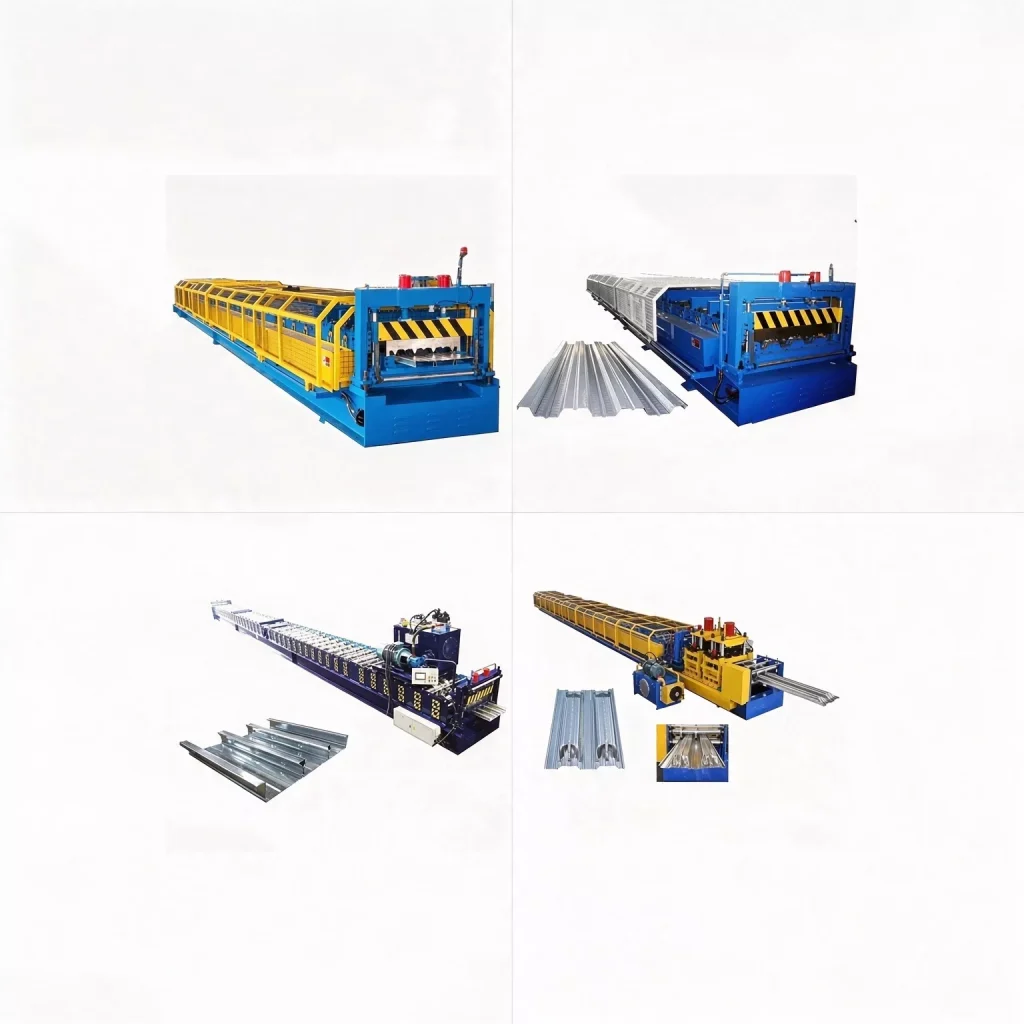
Four floor deck profiles cover almost everything built today: open, closed, re-entrant (dovetail) and truss bottom plate. The family decides roll tooling, pass count and shear arrangement before gauge or output are discussed. Inside a family the section comes from the project drawing, and the numbers in its designation tell you the geometry without opening it.
Step 1 of 5 · Floor Deck Roll Forming Machine: The 5-Step Selection Framework · Xiamen Liming | Zheng Liming Machinery
How to Read a Floor Deck YX Designation
Most floor deck on the international market carries a Chinese designation, because that is where the roll forming capacity sits. The format is consistent, and once you can read it you can compare two profiles at a glance.
For example, take YX144-290-870. YX stands for yaxing, the Chinese term for cold-formed profiled sheet, and prefixes every domestic deck designation. 144 is rib height in millimeters — a deep rib, in this case. 290 is rib pitch, the centre-to-centre distance between adjacent ribs. 870 is effective cover width: what one panel covers once the next sheet laps over it.
Next, the pitch follows the same logic: in YX60-300-600 the ribs stand 60 mm high, sit 300 mm apart, and each panel covers 600 mm. Reading YX40-185-740, you know the ribs stand 40 mm high, sit 185 mm apart, and each panel covers 740 mm: enough to rule a profile in or out against a span table.
Cover width is not development width. Cover width is what you build with, and what quotations and span tables list. Development width — the flat coil width before forming — depends on side laps, stiffeners and lap tabs, and two builders can differ by tens of millimeters on the same nominal profile. It belongs on the tooling drawing, not on a comparison sheet.
Open Floor Deck Profiles
Open decks have open ribs and open edges: cheapest to tool, fastest to install, and conduits run through the ribs without drilling. Material utilisation is high because the section wastes little coil. The trade-off, however, is fire performance — open ribs leave voids that need supplemental fireproof coating.
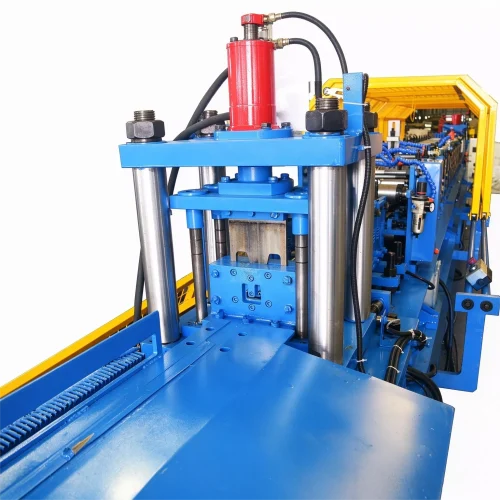
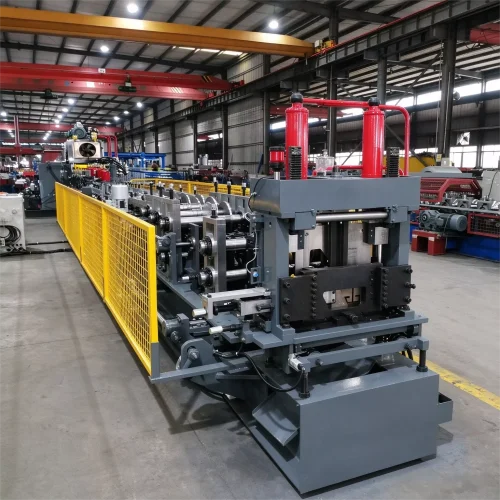
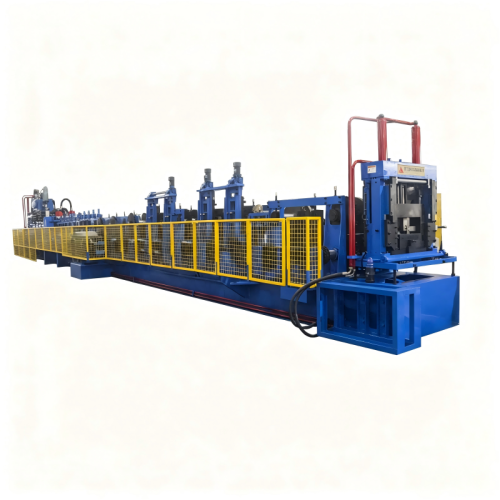
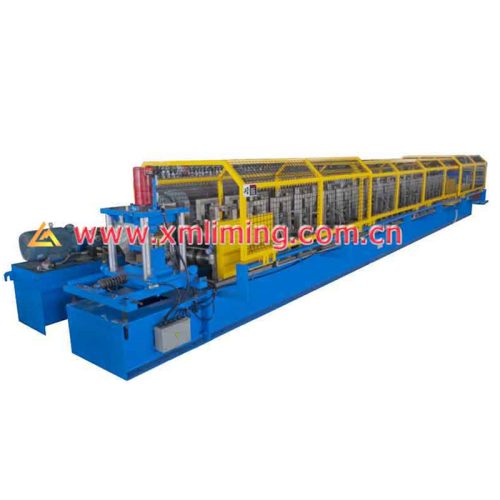
Open profiles account for the largest share of export orders, and the four specifications below are production machines that have run on real projects rather than catalogue entries:
YX60-300-600 — 600 (+6) mm cover width, exported to Malaysia, 0.8–1.2 mm gauge, 32 forming passes.
YX144-290-870 — 870 (±6) mm deep-rib deck, exported to Russia, 0.75–1.5 mm gauge, 38 forming passes.
YX50-330-1000 — 1,000 mm general-purpose profile, 0.8–1.2 mm gauge, 26 forming passes.
YX76-344-688 — 688 mm standard profile, 0.7–1.5 mm gauge.
Four widths and four rib heights cover most requirements in Southeast Asia, the CIS and the Middle East. Typical use: industrial plants, logistics warehouses, long-span buildings.
Closed Floor Deck Profiles
Closed decks seal the rib into a cell with a flat underside. That single geometry change buys three things: no suspended ceiling, because the soffit is already finished; better fire and acoustic performance, since the sealed cell interrupts both paths; and a monolithic slab with integral hangers for MEP services, which removes a round of secondary site work.
For anyone comparing a closed deck floor roll forming machine against an open-profile line, the sealed cell is the entire justification for the extra tooling cost. Nothing else about the machine changes much otherwise: more passes, tighter tolerance on the closing rolls. What you are buying is the section, not the hardware.
Typical sections: YX40-185-740, YX66-240-720, YX65-225-675, all 0.8–1.5 mm. Fire rating is not a property of the profile alone — gauge, slab thickness and fire design all enter into it — so treat a vendor's rating as a starting point for the engineer, not a specification.
Re-entrant (Dovetail) Floor Deck Profiles
The dovetail rib is narrower at the top than at the base. As a result, it keys mechanically into the concrete instead of relying on friction and embossments alone. Joints stay tight under load, lowering the risk of cracking along the rib line and of the deck separating from the slab.
Representative section: YX53-200-600 — 53 mm rib, 200 mm pitch, 600 mm cover, 0.8–1.5 mm. Typical applications are shopping complexes and mid-to-large office buildings, where the dovetail also gives services a natural channel to run in.
Steel Truss Deck — Bottom Plate Only
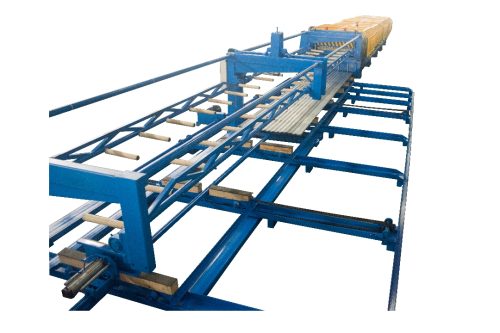
A steel truss deck is two products assembled into one: a profiled steel bottom plate, and a welded truss sitting on top of it. Only the bottom plate comes off a roll forming line. The truss is welded on a dedicated truss welding line, then the two are married in the factory and shipped as complete slabs.
What that buys is span: 6 m and beyond without propping, which an ordinary profiled deck cannot do at any sensible gauge. Therefore, airports, stadiums and long-span buildings accept the second production line.
Budget for two lines. The truss welding line is not part of the roll forming machine. We supply the bottom-plate line alone, or both as a package — but they are two machines. Ordering the plate line and discovering the trusses are somebody else's product is a common and expensive misunderstanding.
Composite vs Non-Composite Floor Deck
A composite deck develops composite action with the concrete: embossments pressed into the web, end anchors, and shear studs welded through the deck transfer shear between steel and concrete, so the two act as one section. High-rise and heavily loaded floors specify it because the profile earns back some of the reinforcement it replaces. Dovetail sections are natural candidates — the mechanical key does part of the work the studs would otherwise carry.
A non-composite deck is formwork and nothing more. It carries wet concrete and construction loads; once the slab cures, the steel is not counted on to work with the concrete. It suits projects where the deck is lost formwork, where speed and cost outrank capacity, or where the slab is lightly loaded.
The practical question is who does the design. If the engineer specified composite action, profile, gauge and stud layout all fall out of that calculation and the machine choice is straightforward. If the deck is formwork only, selection is driven by span during pouring and by gauge.
Floor Deck Profiles and Delivery Data
| Type | Profile | Cover width (mm) | Gauge (mm) | Passes |
|---|---|---|---|---|
| Open | YX60-300-600 | 600 (+6) | 0.8–1.2 | 32 |
| Open | YX144-290-870 | 870 (±6) | 0.75–1.5 | 38 |
| Open | YX50-330-1000 | 1,000 | 0.8–1.2 | 26 |
| Open | YX76-344-688 | 688 | 0.7–1.5 | per profile |
| Closed | YX40-185-740 | 740 | 0.8–1.5 | per profile |
| Closed | YX66-240-720 | 720 | 0.8–1.5 | per profile |
| Closed | YX65-225-675 | 675 | 0.8–1.5 | per profile |
| Dovetail | YX53-200-600 | 600 | 0.8–1.5 | per profile |
For instance, the two export projects show how much configuration hides under one product name. YX60-300-600 ran twin 15 kW motors and a hydraulic rear shear with hold-downs. YX144-290-870 needed 38 passes, three 18.5 kW closed-loop motors, a 15 kW servo shear and a 12 m stacker — same family, but width went from 600 to 870 mm and the gauge ceiling from 1.2 to 1.5 mm, and every downstream component stepped up a class.
How to Pick the Right Floor Deck Profile
Biggest volume at lowest cost: open deck.
Fire rating or finished soffit specified: closed deck.
Composite action, tight joints, moderate cost: dovetail.
Span over 6 m, unpropped: truss bottom plate.
No concrete pour, purlins in the same book:the combo machine.
Frequently Asked Questions About Floor Deck Profiles
How many profiles can one machine run?
One roll tooling set normally serves one profile. As a result, more profiles mean more roll sets or a quick-change design, and both add mill length and cost — which is why profile count is the first thing to settle.
Can you tool a profile from my drawing?
Yes. Send the section drawing and we match tooling to it rather than to a model number. Development and sampling depend on profile complexity — deep ribs, close rib spacing and stiffeners all add passes and lead time.
Send the section drawing. We will confirm the tooling, the pass count for that specific profile, and the gauge tier it lands in — within 24 hours.
Other guides in this framework
- Step 2 — Gauge range and roll tooling
- 0.7–1.5 mm vs 2.0–3.0 mm, thickness tolerance, 45# chrome vs Cr12
- Step 3 — Forming passes, line speed and output
- Why pass counts follow the section, and the capacity formula
- Step 5 — Buyer checklist: nine questions and RFQ
- What to verify before you sign
- The 5-step framework
- Back to the overview